
This article is part of Witness: The Human Impact of Immigration Enforcement, an ongoing documentary project documenting the lives of people affected by immigration enforcement. My goal is to move beyond politics and headlines and help readers better understand the human stories often missing from the conversation.
Read more about the project and how you can participate.
For years, Keri has felt she has been searching for her true self. A family trip to Germany, an encounter with the history of resistance, and a seemingly accidental introduction to immigration court helped her find a direction she hadn’t known how to name.
A Mother Says Goodbye
The mother was standing behind a low barrier in an immigration courtroom, trying to see her son on a video screen—another barrier between a mother and her son.
He was in detention, a young man in his early twenties who had a child of his own in the United States. He was facing removal. His mother had come to court, something Keri Goldstein says she almost never sees during the detained hearings she observes.
At the end of the proceeding, the judge—one Keri remembers as generally kind and respectful—asked whether the mother wanted to speak with her son.
“It’s okay, son,” the mother told him. “This isn’t the end. And I love you.”
“I love you,” he answered.
They could see one another through a screen, but they could not embrace. Keri sat in the courtroom and watched.
“It was just … a really devastating thing to watch,” she told me. “There’s nothing you can do and there’s nothing they can do.”
I keep coming back to that mother. Her son was a person with a mother who loved him, and a child who would still be here after he was gone. Whatever his immigration case involved, those relationships were real. Yet in the machinery of a hearing, they occupied only a few moments.
And I keep coming back to Keri, too. An accountant from Minnetonka. Not a lawyer. Not a professional activist. A woman who had chosen to spend her time sitting in a federal immigration court so that someone, at least, would be there to see what happened.
Why?
That question turns out to be the heart of her story.
The Accountant Who Was Looking for Something
Keri lives in a beautiful home by a lake in Minnetonka. She likes her home. She loves her family and friends. She has worked as an accountant and in restaurants, where she came to know immigrant coworkers as ordinary people trying to work, raise families, and enjoy their lives.
From the outside, it might look as though she has everything she needs.
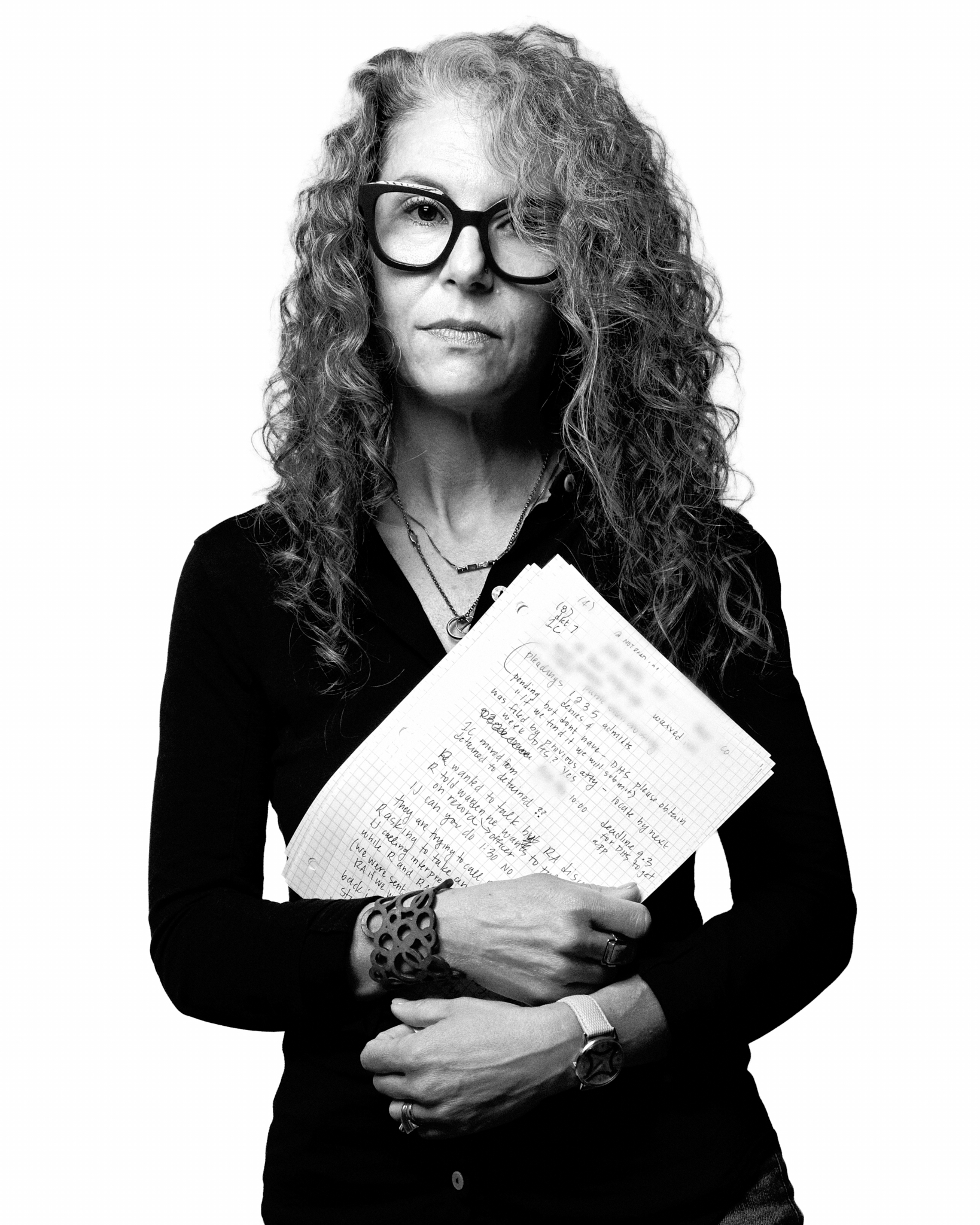
But when I ask who she is away from the courtroom, she doesn’t begin with her résumé. She begins with the search she has been on for years.
“I feel like I’ve always kind of been someone … searching for … my true self.”
She has volunteered on campaigns, joined protests, and worked on social justice causes. She was active in the demonstrations following George Floyd’s murder. She believes those marches matter: they help people recognize that others share their concerns and can lead them into deeper involvement. But for Keri, they never quite became the thing she was looking for.
She wasn’t looking for another activity. She wanted to know she was making an impact.
“What am I leaving in this world?” she asks. “I don’t want to just be … this accountant and I had some hobbies.”
Then comes a line that could explain a great deal about her temperament:
“I love rules. But I hate authority.”
There’s a contradiction worth sitting with. Keri believes in fairness, in procedures that mean something, in systems that should work as promised. But she’s deeply suspicious of power that seems to operate without accountability. She has what she calls a rebel streak, along with an accountant’s instinct to look at the details.
More than anything, she feels other people’s suffering intensely. Sometimes she struggles to understand why the people around her don’t appear to feel the same urgency.
“Why isn’t everyone feeling this deeply and so affected by this?”
That question struck me. Why does one person feel compelled to leave the couch, enter a courtroom, document what happens, and speak about it? Why can someone else see the same headlines and get on with an ordinary day?
I’m not sure it has a simple answer. And Keri, as I came to understand, hasn’t finished searching for hers.
The Trip That Became Something Else
In August 2025, Keri and her husband traveled to Germany to visit their son, who was working at a hotel and restaurant outside Berlin. It was, initially, a family trip.
But Keri wanted to visit a former concentration camp near Berlin. Her husband asked if she really wanted to go.
“Yeah, really,” she remembers telling him. “You can’t go there and not … it’s like our duty to do this. To witness this.”
She had learned about the Holocaust throughout her life. She is Jewish, and the history was never abstract to her. Still, walking through the place was different from knowing about it.
What disturbed her was how ordinary the surroundings were. A train station. A street through a neighborhood. Houses near the camp. She thought about people arriving by train and walking that same street into captivity.
Inside, she saw exhibits about the ways Nazi authorities classified and persecuted human beings. Then she encountered a photograph of someone who had been killed there who shared her last name. Keri did not say they were related. She didn’t have to. The name alone collapsed some of the distance between the history she had studied and the person standing in front of the display.
“This is me,” she remembers thinking.
She wondered about people who ask how atrocities could have happened while neighbors carried on with ordinary lives. To her, the visit made the mechanisms of fear, obedience, and separation feel frighteningly recognizable given what is going on today. That’s Keri’s interpretation, shaped by her history and by what she’s now witnessing. It isn’t a claim that two different historical situations are identical, but the connection is visceral to her.
But the more consequential part of the trip may have come afterward, in Amsterdam.
At the Resistance Museum, she saw exhibits describing people who had acted against Nazi occupation: hidden compartments in baby carriages, underground printing presses, forged documents. Practical, dangerous acts carried out by ordinary people who had decided they could not simply go along.
Keri could see something of herself in that stubbornness. It clicked.
“I have to do this,” she remembers thinking. “I have to figure out … how to be more of an activist.”
That is the turn in her story that interests me most. At the concentration camp, she had confronted what people were capable of doing to one another. At the Resistance Museum, she confronted the question of what people were willing to do for one another.
She returned home with that question still working on her.
The Stranger Who Led Her to Whipple
Keri had already wondered whether she could simply go to immigration court and watch. She didn’t know where to start. She didn’t even know where the hearings were taking place.
Then, at a meeting with Unidos MN1, she met a man who knew about a court-observer project2. He invited her to accompany him and see it for herself.
When they arrived at the Whipple Building, he noticed changes: chairs that had been available in the hallway were gone. He speculated it was due to the Kristi Noem visit3. Keri remembers him remarking that something strange was happening. Over time, she felt that the building was becoming harder for people to navigate, including observers and those appearing for hearings.
She signed up to volunteer. Then man who introduced her to the project disappeared.
I found myself thinking of him as an unlikely guide—someone who appears at precisely the moment she was ready to take another step down this path and then disappears from the story. Keri doesn’t insist that anything supernatural happened. But she talks about these connections with a sense of wonder.
“It’s just kind of evolving in this … organic way,” she says, “but also feels like this fate of … this is your path.”
She follows it.
Court observation fits something in Keri that the marches never quite reached. She can watch closely, record what she sees, and submit reports to a project that may use those observations to identify concerns and document patterns. There is a task. There is a human being in front of her. There is a record to make.
She describes the satisfaction of seeing injustice, reporting it, and knowing somebody cares about the report.
“That’s a real impact.”
There is no grand heroic gesture in this. She goes to court. She pays attention. She writes things down. Then she goes back.
What She Sees When She Gets There
The immigration courtroom Keri describes is small, with a few rows of benches and a video screen. In detained cases4, the person whose future is being decided is often appearing remotely from a detention facility. The government’s attorney may also appear by video.
Keri describes a screen positioned so awkwardly that an observer sometimes has to sit far to one side to see the person appearing on it. I’ve sat in one of these hearings myself. I know what she means: the screen was angled toward the judge, not the people in the back trying to watch.
Sometimes, Keri says, the video quality is so poor that faces disappear into shadows. She has seen people who appeared physically or mentally unwell at one hearing and returned for another. The image was too poor for her to tell how they looked.
So she writes it in her report.
“This is an access issue,” she says. “We can’t see them.”
It’s difficult to imagine a more literal expression of what troubles me about immigration enforcement. A person’s life is being discussed, but even the person’s face is difficult to see.
What troubles Keri goes beyond what happens to the people appearing before these judges. She questions the very structure of the court itself.
Immigration courts are not part of the independent federal judiciary. They operate within the Department of Justice, under the authority of the executive branch. The same branch of government responsible for carrying out the president’s immigration policies also oversees the courts deciding whether people can remain in the country.5
For Keri, that raises a troubling question: How independent can these proceedings be when the administration pursuing deportations also controls the system responsible for adjudicating them?
The evidence gives that question particular urgency. During the first eleven months of Trump’s second term, the number of people held in immigration detention increased by nearly 75%, reaching what was then the highest level on record. Discretionary releases from detention declined by 87%. Beyond those numbers, the administration implemented policies restricting immigration judges’ authority to grant bond, limiting opportunities for some individuals to pursue their cases outside detention. 6
Keri has spent enough time in these courtrooms to recognize the rhythms of the proceedings. She watches how judges conduct hearings, how detainees respond, and how cases move toward their conclusions. She has seen people abandon their applications rather than endure continued detention.
She wonders whether she is witnessing a system genuinely weighing each person’s circumstances or one increasingly shaped by the administration’s determination to remove them.
The distinction matters enormously. These are not abstract legal arguments. The decisions determine whether a mother remains with her children, whether a family stays together, whether someone who fled danger must return to it.
People seeking asylum are entitled to present their claims, submit evidence, testify, and call witnesses during a contested hearing on the merits.7 Yet, Keri says she has witnessed relatively few of these full hearings. Instead, she has watched detained individuals withdraw applications, sometimes because they can no longer bear the circumstances of their detention.
That raises another question: What does the right to a fair hearing mean when someone feels compelled to give up before that hearing takes place?
And Keri keeps returning, watching, documenting, and asking whether what she sees resembles the justice Americans are taught to expect from their courts.
The people she remembers aren’t abstractions.
She describes a mother in the lobby breastfeeding a small baby while she waited. Nearby, another mother sat with her eyes closed as her toddler pushed a stroller around, rolled on the floor, and made the noises toddlers make when they’re trapped in a waiting room for hours.
Keri couldn’t know precisely what the woman was thinking. Perhaps she was praying; perhaps she was exhausted. Keri watched and imagined the daily logistics behind that moment: missed work, childcare, transportation, and the fear that a trip to court might end with a family separated.
A toddler playing with a stroller. A mother trying to hold herself together. These are the details that disappear when we talk about immigration only in categories—legal, illegal, detained, removed.
Keri has worked alongside immigrants. To her, they’re people doing what most people do: going to work, caring for children, building ordinary lives.
The mother and son on the video screen are not the only people she remembers. But they show why she keeps coming back. Without someone there, that goodbye may survive only in the memories of the two people forced to say it.
Two Worlds, and the Space Between Them
Keri’s courtroom work has given her something she didn’t expect: a community.
She talks about meeting other observers, attorneys, and advocates. After the storytelling event where I first heard her speak, she went to dinner with two other women involved in the work. They talked for hours. She didn’t want the evening to end.
For a woman who sometimes feels isolated in her own neighborhood, that matters.
She loves her home and the lake, but says she has trouble connecting with many of the people around her. She isn’t impressed by titles, money, or the possessions people accumulate. She wants to be with people who care about what is happening beyond their own lives.
She tells me about a Fourth of July gathering hosted by her daughter’s boyfriend’s sister. The invitation described it, jokingly or not, as a “socialist Fourth of July.” Keri went, found herself among people having open conversations about society and their lives, and had a wonderful time.
When she came home, she watched three women walking through her neighborhood dressed in a way that, to her, looked straight out of the 1950s. She was struck by the contrast. In the span of an afternoon she’d moved between two worlds that hardly seemed to know each other.
“I get what I need by leaving here,” she says. She seeks out people who “care about what’s happening. And care about people.”
I recognize the feeling. I’ve wondered about people in my own neighborhood who seem able to separate their private comfort from what happens to families elsewhere. How can something feel so urgent to one person and barely register with another?
But I also think Keri complicates my own question. She points out that acting can carry real costs. Not everyone can spend days protesting. People have jobs, bills, children, and health insurance tied to employment. Some avoid the news because they are overwhelmed, or because they don’t know what to do with what they hear. Concern doesn’t automatically produce the time or security to act.
And then there is the way we encounter these stories in the first place.
Keri is sharply critical of a media culture that can reduce enormous human consequences to headlines, competing sound bites, and the next argument. She urges me to watch Democracy Now!, particularly the interviews where affected people are given the time to speak for themselves.
I think she’s touching on something important. We can consume endless coverage of immigration enforcement and still never encounter an immigrant as a full human being. Without that encounter, it is easier to remain in our separate worlds.
Keri wasn’t changed simply by learning another set of facts. She went places. She met people. She saw things that would not leave her alone. And then she found somewhere to put that feeling to work.
Finding Her Voice
On July 14, 2026, I heard Keri speak at the Cedar Cultural Center in Minneapolis. The event, Bearing Witness: Honoring the Power of Communities to Witness, Remember, and Act Together, brought together people whose experiences with immigration enforcement came from different directions: court observation, family separation, legal work, and community support.8
The format reminded me of The Moth. People stood before the audience and told what they had lived or witnessed. No flood of charts. No clever slogan capable of making another family disappear into an argument.
Keri had told me she wasn’t naturally comfortable speaking in public. Yet there she was, standing before a roomful of people, talking about what she had seen and why she could not dismiss it.
I originally approached her because of the connection she’d drawn between what she learned in Germany and what she was seeing in American immigration court—especially the danger of fear and denunciation when people can turn authorities against someone in their own community. Those questions still matter. But after sitting down with her, what stayed with me was something more intimate.
She had spent much of her life trying to find where she could be useful. She had followed a series of experiences without knowing exactly where they would take her. Now she was in a courtroom making a record, and on a stage telling other people why that record mattered.
She says the experience has made her more confident. She is learning how to express strong beliefs without pushing people away. She is educating herself because she wants to know what she’s talking about. And she hopes that when people hear the stories she brings back from court, they’ll feel enough to begin asking questions of their own.
“Because if you don’t feel it,” she tells me, “then who cares? … Then you don’t do anything, and then nothing changes.”
This is where her journey and mine intersect.
I photograph and interview people because I don’t want lives like the ones Keri sees in court to become an abstraction. Keri observes and reports because, as she puts it, without witnesses these stories remain “in the dark.” Neither of us can promise that seeing a person will change a law or bring a son home. But the absence of witnesses makes it easier for a life to pass through a system without leaving a public trace.
Keri hasn’t reached some finished version of herself. She’s still learning, still finding opportunities, still allowing one experience to lead her toward another.
“I’m just letting myself be led,” she says.
I began by wondering why some people feel compelled to act while others look away. I still wonder. But Keri has made me think that perhaps the difference isn’t a single act of courage. Perhaps it’s the willingness to follow an uncomfortable question far enough that it begins to change how you live.
For Keri, the question was simple: What am I leaving in this world?
She is beginning to answer it, one day in court, one report, and one story at a time.
—
- Unidos MN is a Minneapolis-based, grassroots organization that grew out of Minnesota’s DREAMer movement. Led by women and multiracial communities, it organizes working families around immigration rights, education, economic justice, and environmental justice. Its work emphasizes community organizing, leadership development, and building political power among historically marginalized communities.
Sources: Unidos MN — Official Website ↩ - Immigration Court Observation Project (ICOP): Established in 2017, this initiative of The Advocates for Human Rights, in collaboration with the University of Minnesota Law School’s James H. Binger Center for New Americans, places trained volunteers in immigration court at the Bishop Henry Whipple Federal Building in Fort Snelling, Minnesota. Observers document hearings using standardized forms, recording courtroom procedures, treatment of immigrants, access to legal representation, and potential due process violations. Their observations contribute to a database used for research, public reporting, and advocacy intended to improve accountability and protect human rights.
Sources: Immigration Court Observation Project · 2026 Volunteer Manual ↩ - Kristi Noem’s Visit to Whipple: On October 24, 2025, Homeland Security Secretary Kristi Noem visited the Bishop Henry Whipple Federal Building at Fort Snelling, Minnesota, where she held a press conference promoting the Trump administration’s immigration enforcement operations. Noem appeared behind a display of confiscated firearms and drugs while hundreds of protesters gathered outside, including religious leaders and immigrant-rights advocates. Her appearance intensified concerns about expanding ICE operations in Minnesota. The building subsequently became the subject of additional controversy over detention conditions and restrictions on congressional oversight.
Sources: Minnesota Reformer — October 24, 2025 · MPR News — October 24, 2025 ↩ - Detained immigration cases: These are immigration proceedings involving people held in federal immigration custody while the government determines whether they may remain in the United States. Unlike people in non-detained cases, who generally live in their communities while their proceedings continue, detained individuals remain in custody unless released through an applicable legal process. Immigration detention is civil, not criminal punishment, and being detained does not necessarily mean someone has committed a crime. Detained cases are generally scheduled more quickly than non-detained cases, but individuals may still spend weeks or months in custody while their cases proceed. Detention can make it harder to obtain legal representation, gather evidence, communicate with family, and prepare a defense. Some detained individuals appear before immigration judges remotely by video rather than in person. ↩
- Immigration courts and judicial independence: Unlike federal courts established under Article III of the Constitution, immigration courts are administrative tribunals within the Department of Justice’s Executive Office for Immigration Review (EOIR). Immigration judges are appointed by the Attorney General and operate under the Attorney General’s supervision. They are legally required to exercise independent judgment and decide cases impartially, but they are also bound by applicable laws, regulations, and precedential decisions, including those issued by the Attorney General. The Attorney General can review and overturn certain administrative immigration decisions. Immigration enforcement is conducted separately by the Department of Homeland Security, which appears as a party in immigration court proceedings.
Sources: DOJ — Function of the Office of the Chief Immigration Judge; DOJ — Jurisdiction and Authority. ↩ - Expansion of immigration detention: The American Immigration Council’s January 14, 2026 report, Immigration Detention Expansion in Trump’s Second Term, documented an increase from approximately 40,000 people in ICE detention in January 2025 to nearly 66,000 by early December, a rise of almost 75%. The report also found that discretionary releases declined by 87% between January and November 29, 2025, and described administration policies restricting immigration judges’ authority to grant bond.
American Immigration Council — Immigration Detention: Immigration Detention Expansion in Trump’s Second Term, Special Report ↩ - Individual or merits hearings: Immigration removal proceedings are civil administrative proceedings, not criminal trials. When a case proceeds to a contested individual hearing, the person facing removal may present evidence, testify, call witnesses, challenge government evidence, and seek applicable forms of relief, including asylum. These procedural protections do not guarantee a favorable outcome. Keri’s observation that she has witnessed relatively few full merits hearings describes her personal experience; it does not establish how frequently such hearings occur nationally. Sources: DOJ — Learn About Immigration Court; DOJ — Individual Calendar Hearings. ↩
- The Advocates for Human Rights, “Witness for Justice Storytelling Event,” July 14, 2026, listing the event, Cedar Cultural Center, and Acacia Center for Justice as host. ↩

